01 · Start with why
Why this concept matters
Learn how horizontal and vertical components combine to produce projectile motion.

Follow an object through the air and discover why its path is curved.
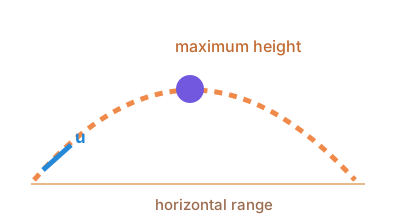
See the idea first. Then give the mathematics a meaning.
Learn how horizontal and vertical components combine to produce projectile motion.
Understand and solve projectile motion problems using component-wise analysis.
Explore the visual idea, follow an example, then try it yourself.
Explore the visual idea, follow an example, then try it yourself.
Explore the visual idea, follow an example, then try it yourself.
Use the concept across the complete NCERT learning path.
Work through published questions connected to this concept.
Move from the physical picture to a worked method, one decision at a time.
Build the depth needed for unfamiliar JEE and NEET applications.
Fast conceptual decisions and accurate application.
Exam practiceMulti-step reasoning with speed and precision.
Deeper problemsChallenge assumptions and connect multiple ideas.
Selected challengesEvery formula belongs to a visual idea.
Horizontal launch-velocity component when the projection angle is measured from the positive x-axis.
Vertical launch-velocity component when the projection angle is measured from the positive x-axis.
Total flight time when the projectile lands at the same height from which it was launched.
Highest vertical displacement above the launch point.
Horizontal distance travelled when launch and landing heights are the same.
Equation of the parabolic path when air resistance is ignored.
Short lessons placed beside the ideas they explain.
Recall the essentials without rereading the whole lesson.